Mostrando entradas con la etiqueta BAS. Mostrar todas las entradas

Marine Aquarium -British Antarctic Survey (BAS)-


One of the most impressive experiences of this summer was that of having live Antarctic brittle stars in my hands – and I took that unique opportunity to identify them. Where? In the Marine Aquarium of British Antarctic Survey (Cambridge).

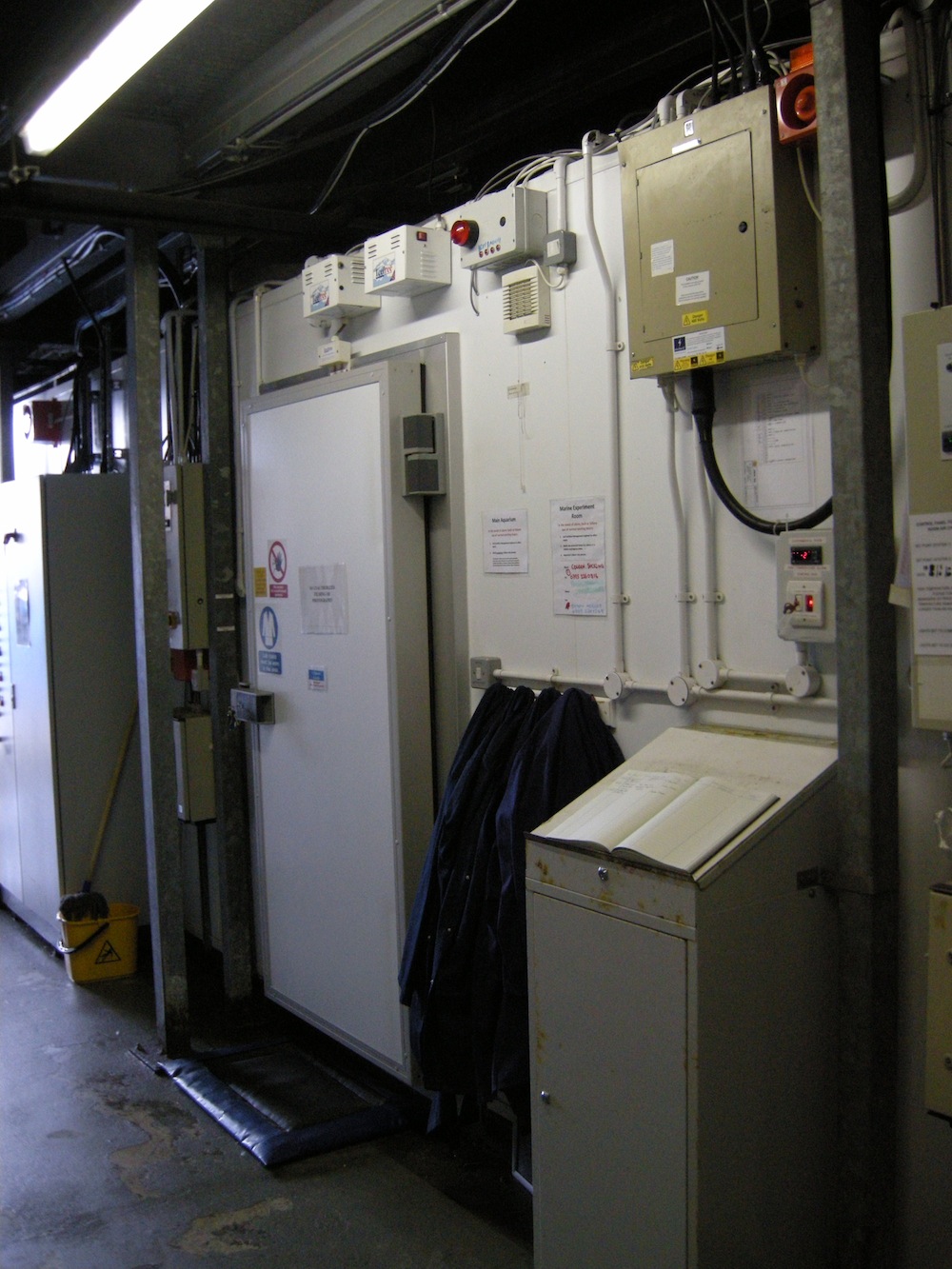
Different aquariums with various zoological groups carefully selected according to their way of life: cnidarians, teleosts, pycnogonids or echinoderms live in marine aquariums situated in a cold room, specially designed to shelter the animals at Antarctic waters temperature.


Sandy Cordiner-Lawrie, Marine Aquarium Manager of Biological Sciences Division (BAS), combining professionalism and affection takes daily care of the fragile marine creatures caught selectively by scuba-divers in Rothera Research Station (Adelaide Island, Antarctida).Among her numerous responsibilities there are those of control of the physico-chemical parameters of the water and maintaining it clean, feeding the animals etc.


Different studies are being carried out, from metabolic routes to growth physiology, and the isolation of the specimens is often needed.


There was a really interesting phenomenon – an “echinoderm swarm”, some kind of caotic concentration of the animals on the wall of one of the tanks, while the rest of the tank was almost empty. It seemed that sea urchins, starfishes (the predator Labidiaster !) and sea cucumbers were desperately seeking a refuge among themselves.


Thank you, Sandy!


September 2010

A day at the Natural History Museum

One typical August morning in London (that means drizzling) Elena and me, accompanied by Chester Sands (molecular ecologist at the British Antarctic Survey BAS) found ourselves at the gates of the British Natural History Museum (NHM).
In the NHM, an architectural ensemble of unique and spectacular beauty, which blends a “cathedral” museum with modern research facilities, we were welcomed by Mr Andrew Cabrinovic, echinoderms curator of the Department of Zoology of the NHM. His kindness and attention to every single detail of our work were really praiseworthy.
The collections, magnificently preserved and neat, were at our disposal, and our “temporary” place of work was equipped with a great stereomicroscopy and a camera to take pictures of the specimens.

The research project which I participate in as ophiuroids taxonomist is about phylogeny and biogeography of Southern Ocean benthos. I’ve already identified several thousand of specimens from several expeditions made by the BAS. During my second stay in Cambridge, I identified the ophiuroids collected by Chester Sands during the expedition ANT XXVII / 3  to South Georgia, Larsen and Bouvet Island on board the German ship Polarstern, organized by the Alfred Wegener Institute (AWI).

To make the identifications reliable, it was necessary to compare our specimens with the specimens preserved in museums, either because some species are represented only by the holotype, or because of the variability or the lack of information of the original descriptions. Thus the aim of the visit was to see the specimens of the ophiuroids collected during expeditions Discovery I (1925) and Discovery II (1936) that constituted the base for one of the major monographs on the Southern Ocean ophiuroids, the work of Theodor Mortensen 1936. I also had the opportunity to see specimens from other expeditions (Challenger 1873-1876 and Quest 1921-1922).


What did that experience mean to me? I mean, the fact of spending a day working in one of the most important zoological research centers worldwide and having in my hands those specimens from the Discovery expeditions after years of rereading the work of Mortensen. Well, I suppose that, besides of a mere fact of collecting information necessary for identification, it could be comparable to the feelings of a Treki in a Star Trek convention being able to take a picture with Leonard Nimoy. Yes, just a day, but a day to remember.
Agosto 2011.

Soy Rafael Martín

Profesor de Biología y Geología en el I.E.S. Santa Bárbara de Málaga. Licenciado en Ciencias Biológicas con especialidad en Zoología y Master en Investigación Científica. 
Estudio organismos marinos de bentos; con especialización en la taxonomía y biogeografía de ofiuroideos (equinodermos) antárticos.

Con un estereomicroscopio (Zeiss Discovery V8) en el Natural History Museum de Londres; viendo especímenes de la expedición Challenger (1872-1876) . 


Así es como llegan los especímenes de las expediciones, conservados en formaldehído o etanol, a la espera de una ardua labor de identificación.

BAS (British Antarctic Survey -Cambridge-).

He realizado estancias de investigación en la British Antarctic Survey (Cambridge; Inglaterra), para el estudio de diversas colecciones de ofiuroideos pertenecientes a expediciones británicas y alemanas al Océano Sur alrededor Antártida.

En el laboratorio de BAS con Chester Sand, ecólogo molecular y Huw Griffths, biogeógrafo marino.

En el laboratorio de BAS con los botes de muestras de ofiuroideos de una expedición británica en aguas del Arco de Scotia en la Antártida; el estereomicroscopio es un Zeiss Stemi SV 6.


En el laboratorio de BAS con estereomicroscopio Leica M65

Ophiosteira bullivanti, fotografía tomada con cámara CCD en un estereomicroscopio Leica M65.


Microscopio electrónico (Quanta 3D FEG/FEI SEM) en la Universidad de Extremadura.

Fotografías SEM (microscopía electrónica de barrido) de Ophiacanta wolftarntzi. Una nueva especie descrita, por el que esto escribe, colectada por el buque de investigación alemán Polarstern en aguas antárticas.

Ofiuroideos antárticos vivos. Estos, conservando su color original, fueron fotografiados momentos después de ser recogidos con una draga Agassiz.

Publicaciones como primer autor:

Brittle stars from Southern Ocean (Echinodermata: Ophiuroidea)

screen-capture

A new brooding species of brittle star (Echinodermata: Ophiuroidea) from Antarctic waters

Publicaciones como coautor:

The macro- and megabenthic fauna on the continental shelf of the eastern Amundsen Sea, Antarctica

.

Observations of the ophiuroids from the West Antarctic sector of the Southern Ocean

Against the flow: evidence of multiple recent invasions of warmer continental shelf waters by a Southern Ocean brittle star
Frontiers

Para saber más sobre los ofiuroideos antárticos puedes hacer click sobre la siguiente imagen: