
Mostrando entradas con la etiqueta Ophiuroids. Mostrar todas las entradas
Mostrando entradas con la etiqueta Ophiuroids. Mostrar todas las entradas


Marine Aquarium -British Antarctic Survey (BAS)-
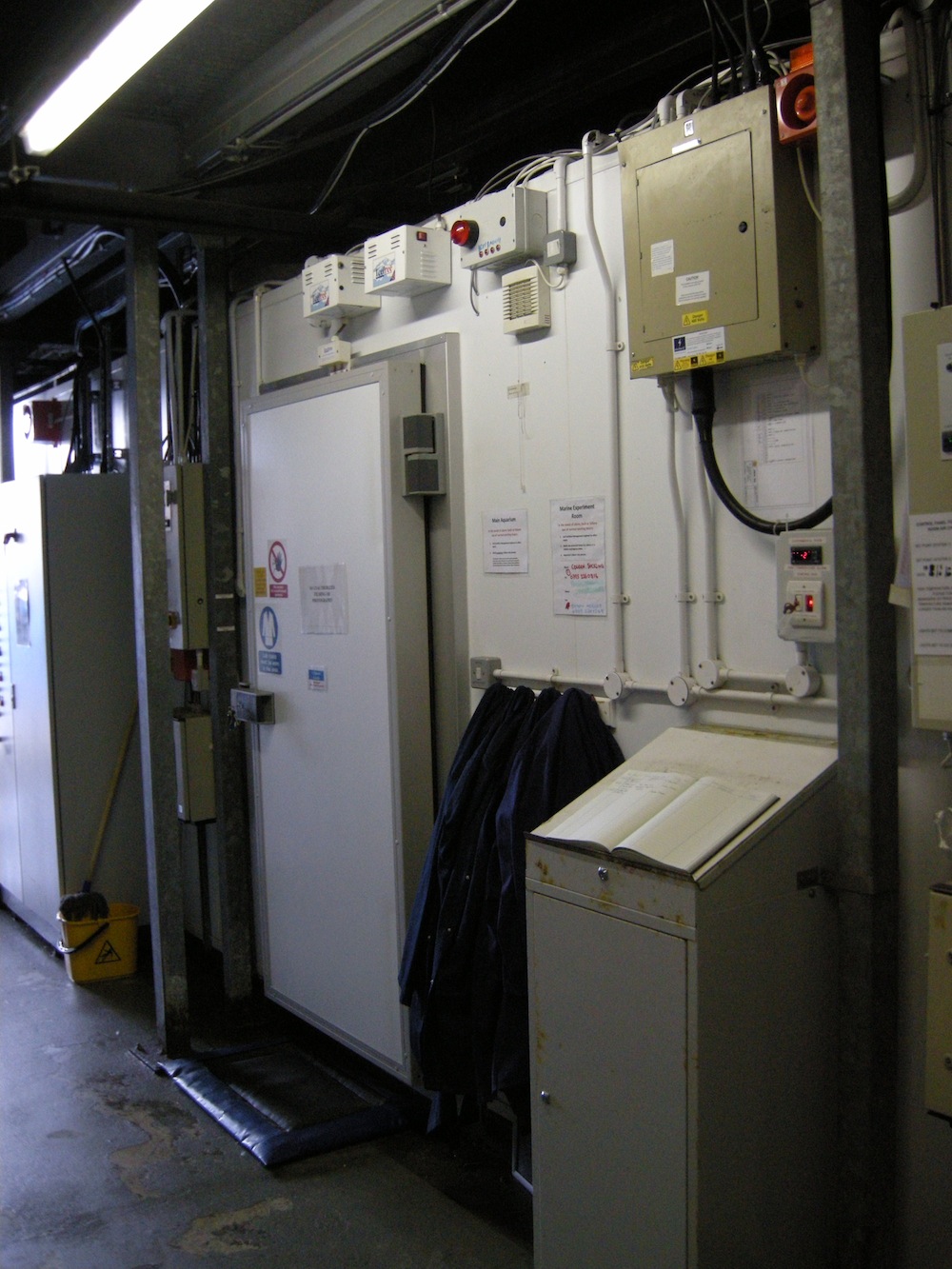
One of the most impressive experiences of this summer was that of having live Antarctic brittle stars in my hands – and I took that unique opportunity to identify them. Where? In the Marine Aquarium of British Antarctic Survey (Cambridge).
Different aquariums with various zoological groups carefully selected according to their way of life: cnidarians, teleosts, pycnogonids or echinoderms live in marine aquariums situated in a cold room, specially designed to shelter the animals at Antarctic waters temperature.

Sandy Cordiner-Lawrie, Marine Aquarium Manager of Biological Sciences Division (BAS), combining professionalism and affection takes daily care of the fragile marine creatures caught selectively by scuba-divers in Rothera Research Station (Adelaide Island, Antarctida).Among her numerous responsibilities there are those of control of the physico-chemical parameters of the water and maintaining it clean, feeding the animals etc.
 Different studies are being carried out, from metabolic routes to growth physiology, and the isolation of the specimens is often needed.
There was a really interesting phenomenon – an “echinoderm swarm”, some kind of caotic concentration of the animals on the wall of one of the tanks, while the rest of the tank was almost empty. It seemed that sea urchins, starfishes (the predator Labidiaster !) and sea cucumbers were desperately seeking a refuge among themselves.

Thank you, Sandy!
September 2010
Symbiosis: Amphiura - Eulimidae (parasitism)
Amphiura joubini: host
Eulimids: endoparasite

In a Amphiura belgicae specimen, caught in South Georgia, Mortensen (1936) described a gastropod that could belong to the same species as the one from the present study. Mortensen described as a possible mechanism of parasite infestation its entrance through an orifice. He also indicated that the adult looked like a sack and had no visible shell.
In the examined specimens of Amphiura joubini from South Shetland we can see externally one or two large whitish interradios. When we opened the animals, we saw a bag with numerous white or flesh colored shells inside the coelom, the adult being globular.

There is no observable orifice through which the gastropod entered, so there is a possibility of its regeneration. However, in one of the specimens that had two parasites in contiguous interradios, the other interradios are open ventrally, which leads us to think that this would be an “exit” mechanism for the gastropods.
This parasitism does not necessarily mean the death of the brittle star, possibly due to its great regenerative capacity. Although this is only a supposition, based on the large number of examined specimens of Amphiura joubini with badly damaged interradios due to the process of youth parasitic forms leaving their host.
There have also been numerous open specimens of Ophiolimna antarctica, without most of the aboral disk, it is hard to find a “whole” specimen in our collection. In one of the specimens a pair of juvenile gastropods were found, so it does not seem to be a specific Amphiura genus parasitism.
Although there is a reference in the literature on the presence of internal eulimidae parasites, not yet been identified at specific level (Anders Waren, pers. Comm.)

Symbiosis: Cancerilla - Ophioika (parasitism)
Ophiuroidea – Copepoda
First the ectoparasites copepods of Antarctic ofiuroids were cited by Mortensen (1936), but without identifying the species, it was Heegaard (1951) who identified them. In the taxonomic literature they have also been cited by Madsen (1967).
Ophiacantha antarctica: host
Cancerilla sp: ectoparasite

The copepods are adhered to the dorsal surface of the disc. Females are carrying their bags of eggs like balls, males have not been found.
Ophiacantha antarctica: host
Ophioika sp: endoparasite

Copepods with modified morphology occupy nearly an entire interradius of the disk. In this species very small males are situated inside of females brood-pouch.
In his review of Ophiuroidea reproduction, Hendler (1991), cites a work of Bartsch (1975) in which he described a castration as a consequence of an ectoparasite copepod (Cancerilla oblonga) in Amphiura capensis. This is an issue to investigate whether in Antarctic ofiuroids there are similar consequences.
Specimens conserved in 70% ethanol, all photographs were made in ethanol.
Collected by Pablo J. González-López. Cruiser ANTARKTIS XXIII/8 Polarstern.
Identified by Rafael Martín-Ledo.
The study was made using Motic SMZ-168 TL stereo microscope.
The study was made using Motic SMZ-168 TL stereo microscope.
References
Heegaard, P (1951) Antarctic parasitic copepods and an ascothoracid cirriped from brittle-stars. Vidensk. Medd. Dan. Naturhist. Foren. 113, 171-190
Hendler, G (1991) Echinodermata: Ophiuroidea. In: Giese, A.C.,
Pearse, J.S. & Pearse, V.B. (Eds.), Reproduction of marine invertebrates: echinoderms and lophophorates. The Boxwood Press, Pacific Grove, CA, pp. 355–511
Madsen FJ (1967) Ophiuroidea. B.A.N.Z. Antarctic Research Expedition (1929–1931) under the Command of Sir Douglas Mawson Rep Ser B 9:123–145
Mortensen T (1936) Echinoidea and Ophiuroidea. Discovery Reports, National Institute of Oceanography Cambridge 12:199–348
July 2010
July 2010
Symbiosis: Ophioplinthus - Ascothorax (parasitism)
Ophioplinthus brevirima: Host
Ascothorax sp: endoparasite


Live Ophioplinthus brevirima, covered by Iophon sponge
Ascothorax sp: endoparasite

Inside there were several parasites (Ascothorax sp) with globose aspect; the smaller ones (probably males) with better distinguished morphology having two valve, while the larger specimens are possibly females. This difference in size, and better conservation of structures in male specimens is a common phenomenon in many parasitic crustaceans.
Ophioplinthus brevirima has short genital slits, hence its specific epithet. In the studied specimens one of the slits, which coincides with the deformed area of the disc has a deformation making it larger, and the proximate plates look abnormal. It is likely had been caused when the endoparasites were leaving their host.

This is supposedly the first record of endoparasites for Ophioplinthus brevirima.
Materials studied from Expediton ANTARKTIS-XXIII/8 Polarstern 2006/2007 in Snow Hill and Dundee Islands. Specimens conserved in 70% ethanol, all photography were made in ethanol using Motic SMZ-168 TL stereo microscope.
Collected by Pablo J. González-López
Identified by Rafael Martín-Ledo
July 2010

Materials studied from Expediton ANTARKTIS-XXIII/8 Polarstern 2006/2007 in Snow Hill and Dundee Islands. Specimens conserved in 70% ethanol, all photography were made in ethanol using Motic SMZ-168 TL stereo microscope.
Collected by Pablo J. González-López
Identified by Rafael Martín-Ledo
July 2010

Some peculiarities of the Antarctic ophiuroids

Mixture of Paleozoic and deep sea fauna
The benthos of shallow-waters in Antarctica is a mixture of:
– Faunas that are common to Australia and New Zealand, South America, South Africa, but also with a large number of endemics.
– Similarities to paleozoic faunas.
– Invasion of the organisms proceeding from the adjacent deep-sea communities.
The absence of crabs and sharks, as well as scarce biodiversity and biomass of teleosts implies a low predation on exoskeleton zoological groups, which causes an abundance in biodiversity and biomass of echinoderms (Aroson & Blake 2001).
Viviparism
Among the Antarctic ophiuroids there is a higher proportion of viviparous species than in other marine areas. Such a thing does not seem to be an adaptation to low temperatures, but to the geographic type of insular habitats of shallow waters and to the insulation by the circumpolar current, the adaptation that prevents the dispersal of larvae Ostergren (1912).
There are viviparous species that are multibrachial (like Ophiacantha vivipara and Ophionotus hexactis), and there are species which are proximate to the aforementioned ones that, being pentamers, are not viviparous (like Ophiacantha pentactis and Ophionotus victoriae). Such a mechanism permits to accommodate more embryos by having more bursae Smirnov (1984).

Ophionotus hexactis with an embryo
Incubation period
The viviparous species have long incubation period (in comparison with the tropical species or the species from temperate waters) and very slow rhythm of growth, measured with Von Bertalanffy growth constant, the fact that indicates that large size individuals are very long-lived, like, for example, in the case of Astrotoma agasiizii, which is one of the largest ophiuroids and whose age calculated from vertebral growth rings can reach 91 years Dahm (1996).
Gigantism
The cases of gigantism among some representatives of the Antarctic fauna can also be found among the ophiuroids; so, while the average disk size of ophiuroids, generally measured in millimeters, is about 10-15 mm, there are some Antarctic ophiuroids with disk size of about some centimeters like, for example, Ophionotus victoriae with disk diameter up to 43 mm, Ophiosparte gigas, up to 60 mm, or Astrotoma agasiizii, up to 60 mm.

Vertebra with growth rings, Ophionothus victoriae
A,distal surface; B,proximal surface; 1,canal for radial nerve; 2,fossa for lower intervertebral muscle; 3,fossa for upper intervertebral muscles; 4, central projection; 5, central depression

Vertebra with growth rings, Astrotoma agassizii
A,distal surface; B,proximal surface 1, hour-glass projection; 2, canal for radial nerve
Can they adapt?
Another peculiarity that suggest the investigations of Peck et al (2009) may be the limited adaptability to environmental variations. His research in aquarium with increasing temperature give for Ophionotus victoriae a scarce survival time. The ophiuroids begin to die from the 24th day at 2 º C, and the 19th at 3 ° C. It seems to suggest that the current global climate change could cause the loss of biodiversity in the Antarctic benthos because of a small temperature increase.
References
Aronson RB, Blake D (2001) Global Climate Change and the Origin of Modern Benthic Communities in Antarctica AMER. ZOOL., 41:27–39
Dahm (1996) Ecology and Population Dynamics of Antarctic Ophiuroids (Echinodermata). Ber. Polarforsch. 194
Peck LL S, Massey A, Thorne M A S, Clark M S (2009) Lack of acclimation in Ophionotus victoriae: brittle stars are not fish. Polar Biol 32: 399-402
Peck LL S, Antartctic marine stenotherms, temperature seasonality and change. Powerpoint presentation.
Östergren, H (1912) Über dieBrutpfl ege der Echinodermen in den Südpolaren Küstengenbieten. Zeitschrift Wissenschaften Zoologie, 101:325– 341
Smirnov IS (1984) Fauna of antarctic and subantarctic brittle-stars. Ph.D . Leningrad. 1984
January 2010
Soy Rafael Martín
Profesor de Biología y Geología en el I.E.S. Santa Bárbara de Málaga. Licenciado en Ciencias Biológicas con especialidad en Zoología y Master en Investigación Científica.
Estudio organismos marinos de bentos; con especialización en la taxonomía y biogeografía de ofiuroideos (equinodermos) antárticos.


 En el laboratorio de BAS con los botes de muestras de ofiuroideos de una expedición británica en aguas del Arco de Scotia en la Antártida; el estereomicroscopio es un Zeiss Stemi SV 6.
 En el laboratorio de BAS con estereomicroscopio Leica M65
 Ophiosteira bullivanti, fotografía tomada con cámara CCD en un estereomicroscopio Leica M65.

 Ofiuroideos antárticos vivos. Estos, conservando su color original, fueron fotografiados momentos después de ser recogidos con una draga Agassiz.



Estudio organismos marinos de bentos; con especialización en la taxonomía y biogeografía de ofiuroideos (equinodermos) antárticos.

Con un estereomicroscopio (Zeiss Discovery V8) en el Natural History Museum de Londres; viendo especímenes de la expedición Challenger (1872-1876) .

Así es como llegan los especímenes de las expediciones, conservados en formaldehído o etanol, a la espera de una ardua labor de identificación.

BAS (British Antarctic Survey -Cambridge-).
He realizado estancias de investigación en la British Antarctic Survey (Cambridge; Inglaterra), para el estudio de diversas colecciones de ofiuroideos pertenecientes a expediciones británicas y alemanas al Océano Sur alrededor Antártida.
 En el laboratorio de BAS con Chester Sand, ecólogo molecular y Huw Griffths, biogeógrafo marino.


Microscopio electrónico (Quanta 3D FEG/FEI SEM) en la Universidad de Extremadura.
 Fotografías SEM (microscopía electrónica de barrido) de Ophiacanta wolftarntzi. Una nueva especie descrita, por el que esto escribe, colectada por el buque de investigación alemán Polarstern en aguas antárticas.


Publicaciones como primer autor:
Brittle stars from Southern Ocean (Echinodermata: Ophiuroidea)
A new brooding species of brittle star (Echinodermata: Ophiuroidea) from Antarctic waters
Publicaciones como coautor:
The macro- and megabenthic fauna on the continental shelf of the eastern Amundsen Sea, Antarctica
Observations of the ophiuroids from the West Antarctic sector of the Southern Ocean
Against the flow: evidence of multiple recent invasions of warmer continental shelf waters by a Southern Ocean brittle star
Para saber más sobre los ofiuroideos antárticos puedes hacer click sobre la siguiente imagen:
Roofs and eyeglasses in Antarctic ophiuroids
In 1961 Fell, in his monograph on the Ross Sea Ophiuroidea, drew attention to the development of skeletal excrecence in Antarctic ophiuroids from Euvondrea and Ophiosteira genera. Fell found no explaination for these outgrowths.

These expansions, especially in the dorsal arm plates, can also be seen in other Antarctic species such as Ophiura (Ophiuroglypha) carinifera, Anophiura banzarei, Ophiomages cristatus, Ophiomastus bispinosus and some species of Ophioplinthus genus.

Ignoring the mere evolutionary whim, there could be various interpretations. For example, passive defense: the protrusive elements could dissuade the predators which would prefer something easier to chew and swallow. Or, acting as peaked roofs somewhere in Siberia or Pirinei Mountains – little flat surface on aboral part protects them from heavy “snowfalls” and, so, doesn’t let them be buried in funds with a high degree of sedimentation. Or, the explanation could be the possible presence of amplifier lenses for photoreception (see symmetrical structures as honeycomb cells of Ophiosteira).

At any rate, nature manifests its spectacularity through the tiniest details of organisms which did not evolve to amaze us, nonetheless, we can’t help being marvelled at them.

November 2011
Symbiosis: Nematoda (parasitism)
Ophioplinthus / Ophionotus - Nematoda


Nematodes, in some cases, can be seen going out from the openings in the disc and, on opening some ofiuroids, several nematodes can be seen spread all over the body cavity.
References
Ophioplinthus gelida (Koehler, 1901): host
Ophionotus victoriae Bell, 1902: host
Nematoda (unidentified): coelomic cavity and bursae endoparasites
Ophionotus victoriae Bell, 1902: host
Nematoda (unidentified): coelomic cavity and bursae endoparasites

Nematodes identified as parasites of Antarctic ofiuroids belong to Thalassonema genus; they have been found in Ophiocten amitinum, although mentioned in sub-Antarctic waters, and in Ophiacantha antarctica. Mortensen 1936, cites the presence of nematodes, unidentified, in Amphiura microplax disjunta.


Nematodes, in some cases, can be seen going out from the openings in the disc and, on opening some ofiuroids, several nematodes can be seen spread all over the body cavity.
References
Jangoux M (1987) Diseases of Echinodermata. II: Agents metazoans (Mesozoa to Bryozoa) Dis aquat org, vol. 2: 205-234
Mortensen T (1936) Echinoidea and Ophiuroidea. Discovery Reports, National Institute of Oceanography Cambridge 12:199–348
Collected by Pablo J. González-López. Cruiser ANTARKTIS XXIII/8 Polarstern.
The study was made using Motic SMZ-168 TL stereo microscope.
July 2010
The study was made using Motic SMZ-168 TL stereo microscope.
July 2010
Ophiosparte gigas, the monster
 Among the specimens that were captured during Australian expedition in 1922, there were three examples of what Koehler considered at that time, apart from the unpleasant appearance due to its thick fleshy skin , as one of the largest ophiuroids ever seen till then, the biggest one of those three had a disk of 48 mm. He assigned it a new genus, Ophiosparte and, due to its size, called it gigas, perhaps he intuited that in future expeditions there would be caught larger specimens, though I doubt he thought that there would have been samples of up to 70 mm of the disk.
Ophiosparte gigas, is one of the most fearsome predators of the Antarctic benthos. Where there is no sharks, crabs and few teleosts, the echinoderms are one of the dominant groups and amog them the brittle stars that, forming dense swarms, cover with their arms large extentions of the bottom. Ophiosparte is not the most abundant species, that role is left to Ophionotus victoriae, something like half fox and half wolf, but once Ophiosparte – the bear – appears, that fox-wolf will not hesitate to run away, crestfallen . Wandering through the soft-bottom, using spatulate brachial spines as oars and helping itself with the chemoreceptors of its brachial tentacles, it tracks its prey and, if starving, it will not be averse to a corpse.

Males and females, probably bad-tempered, will have to meet and be close one to another for spawning to give rise to large larvae, which in Ross and Weddell seas and around the Antarctic Peninsula will be the future of the species, which will remain a mystery for taxonomists who come across it and challenge the traditional systematic doubting whether it is a Ophiacanthidae or Ophiomyxidae, reminding us that those are just the rails of our mind which want to pigeonhole such a marine monster.
The photos was made using Motic SMZ-168 TL stereo microscope.
References
References
Bernasconi I, D’Agostino MM (1974) Equinodermos antárticos. III. Ofiuroideos. 1. Ofiuroideos del extremo norte de la Peninsula Antartica. Revista Museo Argentino de Ciencias Naturales ‘Bernardino Rivadavia’. Hidrobiologia 4(2):80-133
Dearborn JH, Hendler G, Edwards KC (1996) The diet of Ophiosparte gigas (Echinodermata: Ophiuroidea) along the Antarctic Peninsula, with comments on its taxonomic status. Polar Biol 16: 309-320
Fell HB (1961) The Fauna of the Ross Sea: Ophiuroidea. Memoirs of the New Zealand Oceanographic Institute, 18, 1–79.
Koehler R (1922) Echinodermata Ophiuroidea. Scientific Reports Australasian Antarctic Expedition 1911–1914, 8, 1–98
February 2010
Ophiacanthidae or Ophiomyxidae?

Sometimes we have it just in front of our eyes, but only with the help of an open mind and a new form of seeing things it makes apparent.
Alexander Martynov from Zoological Museum of Moscow State University, carrying out a revolutionary systematic work in accordance with the structures of the arm-spine articulation ridges, establishes a surprising and convincing change: Ophiosparte gigas is an archaic member of Ophiuridae family.
Reference
Martynov AV (2010) Structure of the arm spine articulation ridges as a basis for taxonomy of Ophiuroidea (a preliminary report). Echinoderms: Durham. Proceedings of the 12th International Echinoderm Conference. 233-239
April 2010
Suscribirse a:
Entradas (Atom)