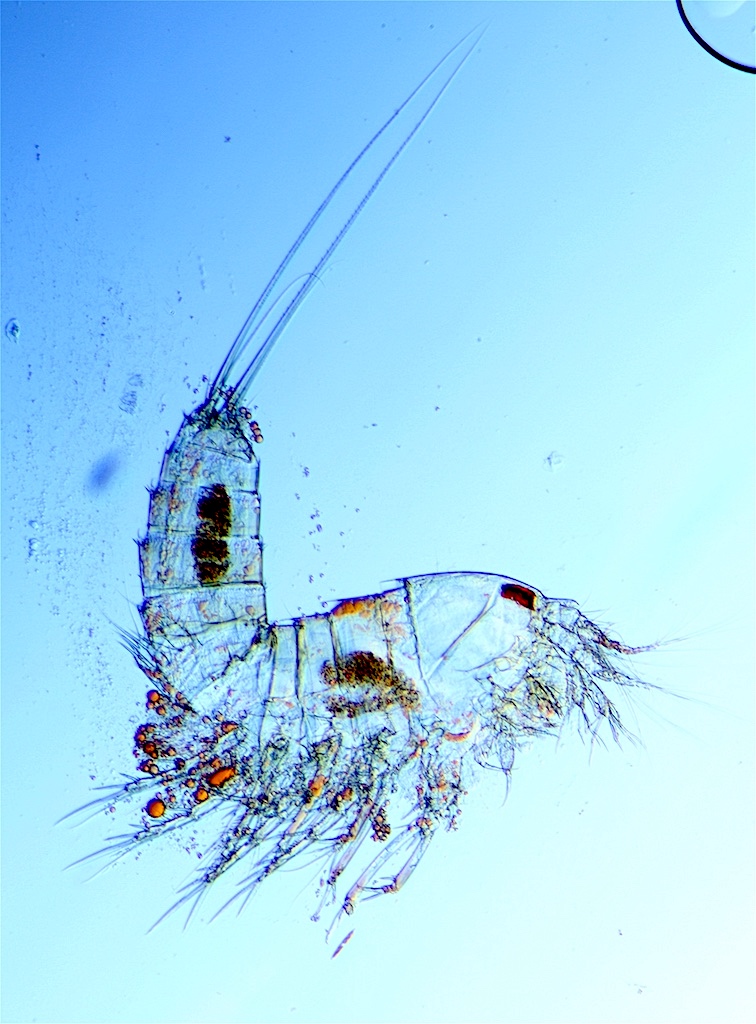
Ophiuroidea – Copepoda
First the ectoparasites copepods of Antarctic ofiuroids were cited by Mortensen (1936), but without identifying the species, it was Heegaard (1951) who identified them. In the taxonomic literature they have also been cited by Madsen (1967).
Ophiacantha antarctica: host
Cancerilla sp: ectoparasite

The copepods are adhered to the dorsal surface of the disc. Females are carrying their bags of eggs like balls, males have not been found.
Ophiacantha antarctica: host
Ophioika sp: endoparasite

Copepods with modified morphology occupy nearly an entire interradius of the disk. In this species very small males are situated inside of females brood-pouch.
In his review of Ophiuroidea reproduction, Hendler (1991), cites a work of Bartsch (1975) in which he described a castration as a consequence of an ectoparasite copepod (Cancerilla oblonga) in Amphiura capensis. This is an issue to investigate whether in Antarctic ofiuroids there are similar consequences.
Specimens conserved in 70% ethanol, all photographs were made in ethanol.
Collected by Pablo J. González-López. Cruiser ANTARKTIS XXIII/8 Polarstern.
Identified by Rafael Martín-Ledo.
The study was made using Motic SMZ-168 TL stereo microscope.
The study was made using Motic SMZ-168 TL stereo microscope.
References
Heegaard, P (1951) Antarctic parasitic copepods and an ascothoracid cirriped from brittle-stars. Vidensk. Medd. Dan. Naturhist. Foren. 113, 171-190
Hendler, G (1991) Echinodermata: Ophiuroidea. In: Giese, A.C.,
Pearse, J.S. & Pearse, V.B. (Eds.), Reproduction of marine invertebrates: echinoderms and lophophorates. The Boxwood Press, Pacific Grove, CA, pp. 355–511
Madsen FJ (1967) Ophiuroidea. B.A.N.Z. Antarctic Research Expedition (1929–1931) under the Command of Sir Douglas Mawson Rep Ser B 9:123–145
Mortensen T (1936) Echinoidea and Ophiuroidea. Discovery Reports, National Institute of Oceanography Cambridge 12:199–348
July 2010
July 2010